


Have you ever gazed up at the sky and marveled at the graceful V-formation of birds soaring across the horizon? Each year, countless birds embark on incredible journeys, traveling thousands of miles to reach their destinations.
But what drives these feathered travelers to undertake such epic migrations? By understanding bird migratory behavior, you can unlock the secrets of nature's most awe-inspiring travelers. We will explore the fascinating world of bird migration, revealing the instincts and patterns that guide them.
You'll discover how these remarkable creatures prepare for their long voyages and what types of behavior are essential for their success. So, if you're curious about the mysteries of bird migration and want to enrich your understanding of this natural phenomenon, you're in the right place. Let's dive deeper into the world of migratory birds and uncover the wonders that await.
Bird Migration Patterns
Bird migratory behavior involves seasonal movement between breeding and wintering grounds. This journey is driven by food availability and climate changes. Birds navigate using instinct, environmental cues, and sometimes learned routes.
Bird migration patterns are one of nature's most fascinating phenomena. They involve complex behaviors that birds use to travel from one habitat to another, often covering thousands of miles. As seasons change, these patterns ensure birds are in environments that provide optimal resources for survival.
Seasonal Movements
Birds are like seasoned travelers, adjusting their journeys to match the changing seasons. You might notice flocks overhead during spring and fall. These are migratory birds moving to areas with better food sources or nesting conditions. Not all birds migrate the same way. Some move short distances, while others travel across continents. This seasonal movement helps them avoid harsh weather and find abundant food. Have you ever wondered how they know when to leave? Birds use environmental cues like daylight length and temperature changes to time their migrations perfectly.
Long-distance Journeys
Imagine traveling thousands of miles without GPS. Birds undertake epic journeys, crossing vast oceans and continents. The Arctic Tern, for instance, migrates from the Arctic to the Antarctic, covering around 44,000 miles annually. During these long-distance flights, birds rely on their incredible navigational skills. They use stars, the sun, and even Earth's magnetic field to find their way. This navigational ability is nothing short of extraordinary. What drives a bird to embark on such a challenging journey? The promise of food, breeding grounds, and safer climates motivates these long flights. Next time you spot a bird soaring overhead, consider the immense journey it might be undertaking.
As you observe these migratory patterns, think about the resilience and adaptability of birds. Their movements are not just about survival; they're a testament to the intricate balance of nature. How can you apply this lesson of adaptation and resilience in your own life?
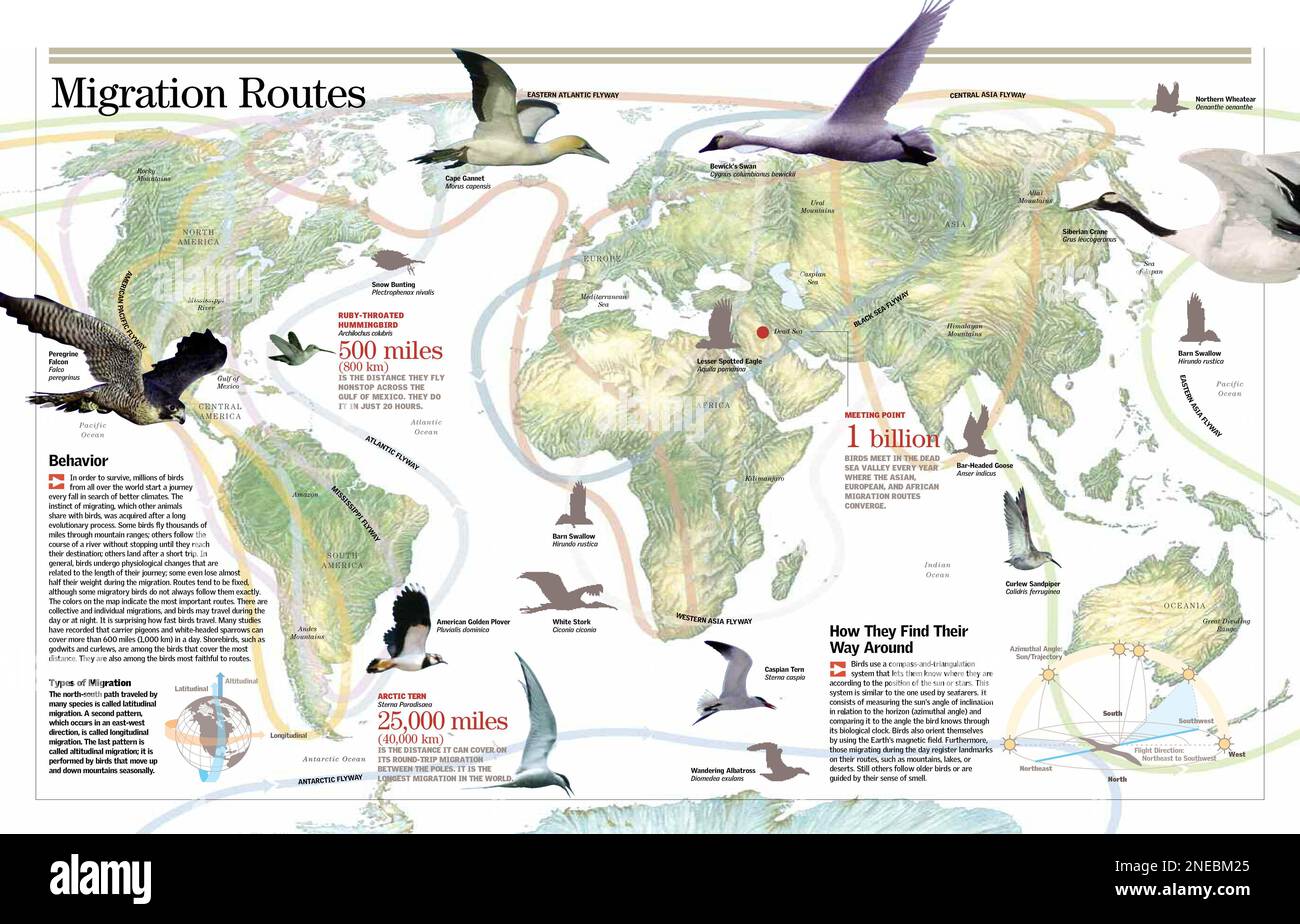
Credit: www.alamy.com
Triggers For Migration
Bird migration is a fascinating natural phenomenon. Triggers for migration are varied and complex. Birds embark on these epic journeys for survival and reproduction. Understanding the triggers helps us appreciate this incredible behavior.
Environmental Cues
Environmental changes signal birds to migrate. Temperature shifts play a significant role. As temperatures drop, birds prepare for their journey. Day length also affects migration patterns. Longer days can mean it's time to move. Food availability is another crucial factor. Scarcity prompts birds to seek resources elsewhere.
Internal Biological Clocks
Birds have internal clocks guiding their migration. These biological clocks are linked to their instinct. Hormonal changes signal when to start migrating. They respond to environmental changes like temperature and light. This internal mechanism ensures timely migrations. It helps birds avoid harsh conditions and find better habitats.
Navigation Techniques
Bird migratory behavior involves seasonal movement between breeding and wintering grounds. Birds navigate using the sun, stars, and Earth's magnetic field. Environmental cues and genetic programming guide their long-distance journeys.
Understanding bird migration unveils fascinating navigation techniques that have intrigued scientists and bird enthusiasts alike. Birds embark on epic journeys, traversing continents with pinpoint accuracy. How do these feathered travelers find their way across vast oceans and dense forests? Let’s dive into the extraordinary methods birds use to navigate their migratory paths.
Magnetic Fields
Birds possess an incredible ability to detect the Earth's magnetic fields. It's like having a built-in compass that guides them on their journey. This magnetic sense helps them orient themselves even on cloudy days when landmarks or the sun are not visible. Studies show that birds have specialized cells in their eyes or beaks that detect these magnetic fields. Imagine having an unseen map that you can always rely on, even in the darkest of nights. It's a remarkable skill that ensures they reach their destination safely.
Star Maps
Birds also utilize the night sky, creating a celestial map to find their way. They are known to navigate using the stars, like ancient mariners charting their course by constellations. You might wonder, how can they possibly recognize star patterns? Research indicates that migratory birds learn the night sky from a young age. They observe the stars' positions and movements, using this information as a reliable guide. Next time you gaze at the stars, imagine a flock of birds soaring confidently, each star a familiar waypoint on their incredible journey.
These navigation techniques reveal the extraordinary capabilities of migratory birds. As you marvel at their journeys, consider the precision and skill involved. What if you could navigate through life's challenges with such clarity and purpose? Understanding bird migration not only enriches our appreciation for nature but also inspires us to trust our instincts and navigate our paths.
Energy Conservation Strategies
Bird migratory behavior involves seasonal travel to find better climates and food resources. These journeys help birds conserve energy by avoiding harsh weather conditions. Efficient energy use is vital for their survival during long migrations.
Birds are remarkable creatures, especially when it comes to their migratory behavior. As they embark on their long journeys, energy conservation becomes crucial for their survival. Birds employ various strategies to ensure they use their energy wisely and reach their destinations safely. These strategies are not just fascinating but also offer insight into nature's ingenuity.
Flight Formation
Have you ever watched a flock of birds flying in a V-formation and wondered why they do this? This unique flight pattern is not just a spectacle for us; it's a highly effective energy-saving strategy. By flying in a V-formation, birds can reduce air resistance. Each bird flies slightly above the bird in front of it, which creates an uplift, allowing the trailing birds to use less energy. This cooperative behavior ensures that the whole flock can travel longer distances with less fatigue. Why don’t humans adopt more cooperative strategies in our daily lives?
Fat Storage
Birds prepare for their migratory journeys by increasing their fat reserves. Fat acts as a high-energy fuel source, crucial for long flights where food might be scarce. Before migration, birds often engage in hyperphagia, where they eat more than usual to build up these fat stores. Imagine the last time you prepared for a long trip, ensuring you had enough snacks for the road. Birds do something similar, but at a much larger scale. They manage to balance their weight to ensure they can still fly efficiently. It's a delicate balance of fuel and flight capability. Have you ever considered how balancing resources in your life can help you achieve your long-term goals more efficiently? Birds’ migratory behavior, particularly their energy conservation strategies, offers valuable lessons in efficiency and cooperation. As you watch the next flock of birds pass by, think about the subtle yet powerful strategies they employ to journey across the globe. Could these strategies inspire changes in your own life?
Challenges In Migration
Bird migratory behavior poses unique challenges. Navigating vast distances requires precise timing and energy management. Weather changes and habitat loss further complicate their journey. Instinct drives birds to find food and suitable nesting areas, ensuring survival during migration.
Migratory birds embark on incredible journeys, traversing thousands of miles to reach their destinations. However, these epic migrations are fraught with numerous challenges. Birds face a myriad of obstacles that test their resilience and adaptability. Whether it's evading predators or battling the unpredictable impacts of climate change, these challenges are significant. As you read, consider what these obstacles mean for the survival of migratory birds and how they adapt to overcome them.
Predators And Hazards
During migration, birds are vulnerable to predators. Imagine a tiny warbler flying across open skies. It's an easy target for hawks or falcons. These birds of prey are always on the lookout for meals. Migrating birds must stay alert and agile, using evasive maneuvers to escape capture. In addition to predators, migratory birds face numerous hazards. Tall buildings, power lines, and wind turbines present real risks. Collisions can cause fatal injuries. Birds must navigate these obstacles carefully. How do they manage such a perilous journey without a GPS? Their innate ability to sense magnetic fields and celestial cues guides them safely.
Climate Change Impacts
Climate change poses a significant threat to migratory birds. Altered weather patterns disrupt their traditional routes. This can lead to exhaustion or starvation if food sources are scarce. Birds rely on cues like temperature and daylight to time their migrations. But with shifting climates, these cues become unreliable. Imagine a bird arriving at its breeding ground only to find it inhospitable. Rising temperatures or unexpected storms can destroy habitats. How do birds adapt to these rapid changes? Some species adjust their migration timing or destinations. Yet, not all can adapt quickly enough. These impacts raise concerns about their long-term survival. As you ponder these challenges, ask yourself: What can we do to help migratory birds in their epic journeys? Protecting habitats and reducing human-induced hazards can make a difference. Your actions can ensure future generations witness the awe-inspiring sight of birds in flight.

Credit: biologicalsciences.uchicago.edu
Conservation Efforts
Bird migratory behavior involves seasonal movement between breeding and wintering grounds. This natural phenomenon helps birds find food and suitable habitats. Understanding these patterns is crucial for conservation efforts, ensuring safe migration routes and protecting habitats along the way.
Conservation efforts play a crucial role in ensuring the safe passage of migratory birds. These birds undertake incredible journeys, sometimes spanning thousands of miles. However, they face numerous threats, from habitat loss to climate change. As someone who once marveled at the sight of a flock of geese flying overhead, you might wonder how we can protect these magnificent travelers. Let's dive into some specific strategies that help safeguard their journeys.
Protected Migration Corridors
Imagine a highway designed exclusively for birds. Protected migration corridors serve as safe routes for birds during their annual journeys. These corridors are essential because they ensure birds have access to food, water, and shelter along their migration paths. Governments and NGOs collaborate to designate these corridors, preserving vital habitats and reducing human interference. You can even support these efforts by advocating for policies that protect these areas. Have you ever thought about what happens if one of these corridors gets disrupted?
Research And Monitoring
Research and monitoring are key to understanding bird migratory behavior. Scientists use technology like GPS trackers to follow bird movements, gathering data that informs conservation strategies. This research helps identify critical stopover sites, which are then prioritized for protection. Monitoring also involves community science projects, where bird watchers contribute sightings. You can join such initiatives, becoming an active participant in conservation. What if your observation could help protect a threatened species? These efforts offer hope for migratory birds, but they need your support. Whether through advocacy, participation in community science, or simply spreading the word, you can make a difference.
Cultural Significance Of Migration
Bird migratory behavior involves seasonal movement for survival. Birds travel long distances to find food and breeding grounds. This natural phenomenon has deep cultural significance, influencing art, folklore, and traditions worldwide.
Bird migration is a fascinating natural phenomenon. It captivates cultures worldwide. Birds travel long distances in search of favorable climates. Their journeys have inspired humans for centuries. Understanding the cultural significance of migration helps us appreciate these winged travelers.
Symbolism In Human Culture
Bird migration symbolizes freedom and hope. Many cultures view migrating birds as messengers. They signify change and new beginnings. Ancient myths often depict birds as guides. Their flight patterns influence art and poetry. People admire their determination and endurance. They inspire stories of resilience and courage. Birds connect us to the rhythm of nature. Their journeys reflect life's cycles and transitions.
Economic Impacts Of Birdwatching
Birdwatching attracts tourists worldwide. It boosts local economies significantly. Many travel to witness migration spectacles. Hotels, guides, and local businesses benefit. Birdwatching provides jobs in rural areas. It promotes conservation efforts too. Protecting habitats becomes a priority. Communities invest in eco-friendly initiatives. Birdwatching fosters environmental awareness. It encourages sustainable practices globally. Tourists contribute to conservation funds. This supports ongoing research and education.

Credit: www.allaboutbirds.org
Frequently Asked Questions
What Triggers Bird Migration?
Bird migration is triggered by environmental changes, like temperature shifts and daylight length. These changes signal birds to move to areas with better resources. Birds also migrate due to food scarcity and breeding needs, ensuring survival and reproduction in favorable conditions.
How Do Birds Navigate During Migration?
Birds navigate using Earth's magnetic field, star patterns, and landmarks. Their remarkable ability allows them to travel long distances accurately. Additionally, some species have innate genetic maps guiding them. These navigation skills are crucial for reaching their destinations safely.
Why Do Birds Migrate Seasonally?
Birds migrate seasonally to access food and breeding grounds. Migration helps them avoid harsh weather and find resources. Seasonal changes in weather and food availability drive birds to move to areas where survival is easier. This cyclical movement ensures their population's continuity.
Do All Bird Species Migrate?
Not all bird species migrate; some remain sedentary. Sedentary birds stay in the same region year-round, adapting to local conditions. Migratory behavior varies among species based on climate, food availability, and breeding needs. Some birds only migrate short distances, while others travel thousands of miles.
Conclusion
Bird migration is a fascinating natural behavior. Birds travel vast distances for survival. They seek food, breeding grounds, and favorable climates. This journey is instinctive and necessary. Understanding bird migration helps us appreciate nature's wonders. It also highlights the importance of preserving habitats.
With climate change and habitat loss, birds face challenges. Protecting their migratory routes is crucial. This ensures they continue their vital journeys. Observing these patterns enriches our connection with wildlife. Birds remind us of nature's rhythm and beauty. Keep exploring and learning about these incredible creatures.
Their journeys tell a story of resilience and adaptation.